
Navigate the dynamic world of commodity options trading, where fortunes are made and lost on the fluctuating prices of everything from gold and oil to agricultural products. This journey delves into the intricacies of options contracts, exploring their unique features and how they can be leveraged for both hedging and speculation. We’ll unravel the complexities of market forces, pricing models, and risk management strategies, empowering you to make informed decisions in this exciting yet challenging arena.
Understanding commodity options trading requires a grasp of fundamental concepts such as strike prices, expiration dates, and premiums. We’ll explore how factors like supply and demand, geopolitical events, and market speculation influence commodity prices, and how different options strategies – from bull and bear spreads to straddles – can be employed to capitalize on these movements. This guide also provides a clear understanding of risk management techniques to mitigate potential losses.
Introduction to Commodity Options Trading
Commodity options trading offers investors a way to speculate on or hedge against price fluctuations in various raw materials. Unlike directly buying or selling the physical commodity, options provide a leveraged approach with defined risk and potential reward. Understanding the mechanics of these contracts is crucial for successful participation in this market.
Commodity Options Contracts and Key Features
A commodity options contract grants the buyer the right, but not the obligation, to buy (call option) or sell (put option) a specific quantity of a commodity at a predetermined price (the strike price) on or before a specific date (the expiration date). The buyer pays a premium to the seller for this right. The seller is obligated to fulfill the contract if the buyer exercises their right.
The premium reflects market expectations regarding the future price movement of the underlying commodity and its volatility. Options contracts are standardized, meaning the quantity and delivery terms are predefined for each commodity.
Examples of Traded Commodities
A wide range of commodities are traded using options contracts. Some of the most prominent include precious metals like gold and silver, energy products such as crude oil and natural gas, and agricultural products such as corn, soybeans, and wheat. The specific commodities available for options trading will vary depending on the exchange. For instance, the Chicago Mercantile Exchange (CME Group) offers options contracts on a vast array of commodities.
Comparison of Call and Put Options
The following table illustrates the key differences between call and put options:
| Feature | Call Option | Put Option |
|---|---|---|
| Right to | Buy the underlying commodity | Sell the underlying commodity |
| Profit Potential | Unlimited (theoretically) | Limited to the strike price |
| Maximum Loss | Premium paid | Premium paid |
| Best Used When | Expecting price increase | Expecting price decrease |
Understanding Commodity Markets
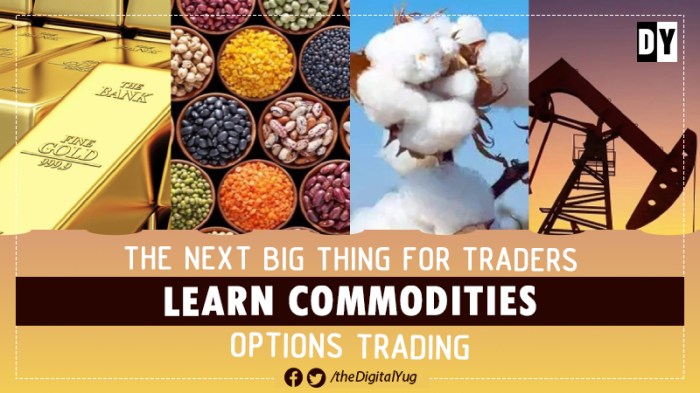
Commodity markets are dynamic systems influenced by a complex interplay of factors, making them both lucrative and risky for traders. Understanding these underlying forces is crucial for successful navigation of this market landscape. This section delves into the key elements shaping commodity prices and the roles of speculation and hedging within these markets. We will also explore the distinctions between physical and financial commodity markets.
Factors Influencing Commodity Prices
Commodity prices are determined by the fundamental economic principle of supply and demand. High demand coupled with low supply typically leads to price increases, while the opposite scenario usually results in price decreases. However, this relationship is far from simple, influenced by a multitude of interconnected factors. Geopolitical instability, for example, can significantly disrupt supply chains, leading to price volatility.
Unexpected weather events, such as droughts or floods, can also drastically impact agricultural commodity production and prices. Furthermore, technological advancements can affect production efficiency and subsequently, prices. Government policies, including tariffs and subsidies, play a crucial role in shaping the market environment. Finally, the overall economic climate, including inflation and interest rates, exerts a considerable influence on commodity price movements.
The Role of Speculation and Hedging in Commodity Markets
Speculation and hedging are two distinct, yet intertwined, activities within commodity markets. Speculators aim to profit from price fluctuations, taking long or short positions based on their market outlook. They actively contribute to market liquidity, but their actions can also exacerbate price volatility. Hedging, on the other hand, is a risk management strategy employed by businesses to mitigate price fluctuations of commodities they use in their production or sell as part of their business.
For example, an airline might hedge against rising jet fuel prices to protect its profit margins. The interplay between speculators and hedgers creates a dynamic market environment where prices reflect both short-term trading sentiment and long-term supply and demand fundamentals.
Physical and Financial Commodity Markets
The commodity market is broadly categorized into physical and financial markets. The physical market involves the actual buying and selling of commodities, such as crude oil being traded for delivery at a specific location and time. This market includes producers, consumers, and merchants involved in the physical handling and transportation of commodities. The financial market, conversely, deals with derivative instruments like futures and options contracts.
These contracts derive their value from the underlying physical commodity but are traded independently, offering opportunities for speculation and hedging without the need for physical delivery. The two markets are interconnected, with prices in the financial market often influencing prices in the physical market, and vice versa.
Historical Volatility of Crude Oil
Crude oil serves as a prime example of a commodity exhibiting significant price volatility throughout history. The following timeline provides a simplified overview, focusing on major price shifts:
| Year | Event/Factor | Price Impact |
|---|---|---|
| 1973 | OPEC oil embargo | Sharp price increase |
| 1979 | Iranian Revolution | Significant price surge |
| 1986 | Oil glut | Sharp price decline |
| 2008 | Global financial crisis | Significant price drop followed by recovery |
| 2014 | Increased US shale oil production | Price decline |
| 2020 | COVID-19 pandemic and reduced demand | Significant price crash |
| 2022 | Russia-Ukraine war | Sharp price increase |
Note: This is a simplified representation. Actual price movements are complex and influenced by numerous other factors. Detailed price data can be found through various financial data providers.
Strategies in Commodity Options Trading
Commodity options trading offers a diverse range of strategies, each with its own risk-reward profile and suitability for different market conditions. Understanding these strategies is crucial for successful trading, allowing you to tailor your approach to your specific outlook and risk tolerance. Effective strategy selection depends on factors such as your market prediction (bullish, bearish, or neutral), your risk appetite, and your capital constraints.
Bull Spreads, Bear Spreads, and Straddles
These are three fundamental options strategies that illustrate different approaches to profit from price movements. A bull spread profits from a rising price, a bear spread profits from a falling price, and a straddle profits from significant price movement in either direction. Let’s examine each in detail.A bull call spread involves buying a call option at a lower strike price and simultaneously selling a call option at a higher strike price.
Both options have the same expiration date. The maximum profit is limited to the difference between the strike prices minus the net premium paid, while the maximum loss is limited to the net premium paid. This strategy is suitable when you anticipate a moderate price increase. For example, if you believe the price of corn will rise from $6 to $7 per bushel, a bull call spread might be appropriate.Conversely, a bear put spread involves buying a put option at a higher strike price and simultaneously selling a put option at a lower strike price, both with the same expiration date.
This strategy profits from a price decline, with maximum profit limited to the difference between the strike prices minus the net premium paid and maximum loss limited to the net premium paid. This is useful when you expect a moderate price decrease. Imagine you believe the price of natural gas will fall from $4 to $3 per MMBtu; a bear put spread could be a suitable strategy.A straddle involves buying both a call and a put option with the same strike price and expiration date.
This strategy profits from significant price volatility, regardless of direction. The maximum profit is theoretically unlimited for the call side and the put side, while the maximum loss is limited to the total premium paid for both options. A straddle is appropriate when you anticipate a large price swing but are uncertain about the direction. For example, if a major weather event is anticipated, potentially impacting agricultural commodity prices significantly, a straddle on soybean futures might be considered.
Hedging and Speculation with Commodity Options
Commodity options provide tools for both hedging and speculation. Hedging involves reducing risk by offsetting potential losses from price movements, while speculation aims to profit from anticipated price changes.Using options for hedging: A farmer expecting to sell a corn harvest in three months could buy put options to protect against a price decline. If the price falls below the strike price, the put options would provide compensation.
This limits potential losses from unfavorable price movements. This is a form of price protection.Using options for speculation: An investor believing that silver prices will increase significantly might buy call options. If the price rises above the strike price, the investor profits from the option’s value. This is a leveraged bet on a price increase, potentially offering high returns but also high risk.
Risk and Reward Summary
The table below summarizes the risk and reward profiles of the discussed strategies. Note that the actual profit or loss can vary based on the specific option prices and the underlying commodity’s price movement.
| Strategy | Suitable Market Condition | Maximum Profit | Maximum Loss | Risk Profile |
|---|---|---|---|---|
| Bull Call Spread | Anticipating a moderate price increase | Difference between strike prices minus net premium | Net premium paid | Limited risk, limited reward |
| Bear Put Spread | Anticipating a moderate price decrease | Difference between strike prices minus net premium | Net premium paid | Limited risk, limited reward |
| Straddle | Anticipating significant price volatility | Theoretically unlimited | Total premium paid | High risk, high reward potential |
Options Pricing and Valuation
Commodity options, like other options, derive their value from the interplay of several key factors. Understanding these factors is crucial for effective trading and risk management. This section delves into the mechanics of commodity options pricing, focusing on the dominant influences and a widely used valuation model.
Factors Determining Commodity Options Prices
Several interconnected factors influence the price of a commodity option. These factors dynamically interact, creating a complex pricing environment. Ignoring any of these factors can lead to inaccurate valuations and potentially poor trading decisions.
- Underlying Price: The price of the underlying commodity is the most significant factor. Call options increase in value as the underlying price rises, while put options gain value as the underlying price falls. This relationship is directly proportional, with a stronger impact closer to the expiration date.
- Volatility: Volatility, measured by the standard deviation of the underlying asset’s price movements, significantly impacts option prices. Higher volatility increases the probability of large price swings, boosting the value of both call and put options. This is because higher volatility offers a greater chance of the option finishing in-the-money.
- Time to Expiration: The time remaining until the option expires is a critical factor. Options with longer maturities generally have higher values than those with shorter maturities, due to the increased potential for price movements. This is often referred to as time decay, as the value of an option erodes as it approaches expiration.
- Interest Rates: Interest rates influence the present value of the future payoff from an option. Higher interest rates tend to increase the value of call options and decrease the value of put options. This is because higher interest rates increase the opportunity cost of holding the underlying asset.
The Black-Scholes Model and Commodity Options
The Black-Scholes model is a widely used method for pricing options. While it has limitations, particularly in accurately reflecting the volatility of commodities which can exhibit jumps and spikes, it provides a valuable theoretical framework. The model assumes that the price of the underlying asset follows a geometric Brownian motion, and it utilizes several of the factors previously discussed to derive a theoretical price.
Calculating Theoretical Option Value
The Black-Scholes model provides a formula for calculating the theoretical value of a European-style call option:
C = S
- N(d1)
- X
- e-rT
- N(d2)
Where:* C = Call option price
- S = Current price of the underlying asset
- X = Strike price of the option
- r = Risk-free interest rate
- T = Time to expiration (in years)
- N() = Cumulative standard normal distribution function
- d1 = [ln(S/X) + (r + σ²/2)
- T] / (σ
- √T)
- d2 = d1 – σ
- √T
- σ = Volatility of the underlying asset
A similar formula exists for put options. Note that accurately determining the volatility (σ) is often the most challenging aspect of applying the Black-Scholes model. Various methods, including historical volatility and implied volatility, are used to estimate this parameter.
Hypothetical Scenario: Impact of Underlying Price Changes
Let’s consider a hypothetical scenario involving a gold call option. Assume the following parameters:* Current gold price (S): $1,800 per ounce
Strike price (X)
$1,850 per ounce
Time to expiration (T)
3 months (0.25 years)
Risk-free interest rate (r)
5% per annum (0.05)
Volatility (σ)
20% (0.20)Using the Black-Scholes formula (or a financial calculator/software), we can calculate a theoretical call option price. Now, let’s see how a change in the underlying gold price affects the option value.If the gold price rises to $1,900, the call option value will increase significantly because it is now further in-the-money. Conversely, if the gold price falls to $1,700, the call option value will decrease substantially, potentially approaching zero.
This demonstrates the direct relationship between the underlying asset’s price and the value of a call option. Similar analyses can be performed for put options, showing their inverse relationship with the underlying asset’s price.
Risk Management in Commodity Options Trading
Commodity options trading, while offering significant profit potential, carries inherent risks. A robust risk management strategy is crucial for mitigating potential losses and ensuring long-term success in this dynamic market. Understanding and proactively addressing these risks is paramount to responsible trading.
Potential Risks in Commodity Options Trading
Commodity options trading exposes traders to several key risks. Market risk stems from unfavorable price movements in the underlying commodity. For example, a sudden drop in oil prices could significantly reduce the value of call options held on oil futures contracts. Liquidity risk refers to the difficulty in quickly buying or selling options contracts without significantly impacting their price, particularly for less liquid commodities.
Counterparty risk, relevant primarily for over-the-counter (OTC) options, involves the risk of the other party in the transaction defaulting on their obligations. This risk is generally mitigated when trading standardized options contracts on regulated exchanges.
Risk Management Techniques
Several techniques can effectively manage the risks inherent in commodity options trading. Stop-loss orders automatically sell an option contract when its price falls below a predetermined level, limiting potential losses. Diversification involves spreading investments across different commodities and option strategies, reducing the impact of adverse price movements in any single market. Position sizing, determining the appropriate number of contracts to trade, is crucial for controlling overall risk exposure.
A well-defined position sizing strategy should consider both the trader’s risk tolerance and the volatility of the underlying commodity. For example, a trader might choose to allocate only a small percentage of their capital to any single trade.
Importance of Understanding Risk Tolerance
Before engaging in commodity options trading, it is essential to understand your personal risk tolerance. Risk tolerance reflects an individual’s comfort level with the possibility of losses. A conservative trader with a low risk tolerance might favor smaller positions and utilize stop-loss orders extensively. Conversely, a more aggressive trader with a higher risk tolerance might be comfortable with larger positions and potentially higher risk strategies.
Determining your risk tolerance involves honestly assessing your financial situation, investment goals, and emotional response to potential losses. Ignoring your risk tolerance can lead to impulsive decisions and potentially devastating financial consequences.
Developing a Comprehensive Risk Management Plan
A comprehensive risk management plan is essential for successful commodity options trading. The following flowchart illustrates the steps involved:[Flowchart Description: The flowchart begins with “Define Trading Objectives and Risk Tolerance.” This leads to “Identify Potential Risks (Market, Liquidity, Counterparty).” This branches to “Develop Risk Mitigation Strategies (Stop-Loss Orders, Diversification, Position Sizing).” This then leads to “Implement and Monitor Trading Plan.” Finally, this leads to “Regularly Review and Adjust Plan as Needed.”] This iterative process ensures the risk management plan remains relevant and effective in the ever-changing commodity markets.
The plan should be regularly reviewed and adjusted based on market conditions, trading performance, and changes in the trader’s risk tolerance. For example, if market volatility increases, a trader might reduce their position size or tighten their stop-loss orders.
Commodities Trading
Commodities trading encompasses a vast and dynamic market involving the exchange of raw materials and primary agricultural products. Understanding the diverse landscape of commodities, the mechanics of trading them, and the roles of various market participants is crucial for navigating this complex arena. This section will provide a broader perspective on commodities trading, exploring different commodity types, contrasting trading instruments, and examining the role of exchanges and clearinghouses.
A real-world example will further illustrate the intricacies of this market.
Types of Commodities Traded
The commodities market is segmented into several key categories, each with its own unique characteristics and influencing factors. These categories are broadly classified as energy, metals, agriculture, and livestock. Energy commodities include crude oil, natural gas, and heating oil, whose prices are heavily influenced by global supply and demand, geopolitical events, and technological advancements. Metals encompass precious metals like gold and silver, as well as industrial metals such as copper, aluminum, and iron ore, with demand driven by manufacturing activity and economic growth.
Agricultural commodities include grains (corn, wheat, soybeans), softs (coffee, sugar, cocoa), and oilseeds, subject to weather patterns, crop yields, and global food demand. Finally, livestock commodities, such as cattle and hogs, are sensitive to factors like feed costs, consumer preferences, and disease outbreaks.
Futures Contracts versus Options Contracts
Futures and options contracts are two primary instruments used in commodities trading, each offering distinct risk-reward profiles. Futures contracts obligate the buyer to purchase and the seller to sell a specified quantity of a commodity at a predetermined price on a future date. This creates price certainty for both parties but exposes them to significant price risk if market conditions change.
In contrast, options contracts grant the buyer the right, but not the obligation, to buy (call option) or sell (put option) a commodity at a specific price (strike price) on or before a certain date (expiration date). Options trading offers greater flexibility and risk management capabilities, allowing traders to define their risk exposure and profit potential more precisely.
The Role of Exchanges and Clearinghouses
Commodities exchanges provide a centralized platform for trading standardized contracts, ensuring transparency, liquidity, and price discovery. They establish trading rules, monitor transactions, and disseminate market data. Clearinghouses act as intermediaries, guaranteeing the performance of both buyers and sellers. They manage counterparty risk by ensuring that transactions are settled efficiently and that any losses are covered, promoting market stability and reducing systemic risk.
The standardized contracts and regulated environment offered by exchanges and clearinghouses are essential for the smooth functioning of the commodities market.
A Real-World Example: Crude Oil Trading
Consider a scenario where a large oil refinery anticipates a need for a significant quantity of crude oil three months into the future. To hedge against potential price increases, the refinery might enter into a futures contract to buy crude oil at a specific price on a specified future date. Simultaneously, a hedge fund manager believes that crude oil prices will decline due to increased global supply.
They might sell a futures contract, betting on a price decrease. If the price of crude oil indeed falls, the hedge fund profits, while the refinery secures its oil supply at a predetermined, potentially advantageous price. The exchange facilitates this trade, and the clearinghouse ensures the transaction is settled, mitigating the risk for both parties. The outcome depends on the actual price movement of crude oil during the three-month period.
If the price rises, the refinery benefits from its hedging strategy, while the hedge fund incurs a loss. Conversely, if the price falls, the hedge fund profits, and the refinery may have locked in a slightly higher price than the prevailing market price at the time of delivery.
Mastering commodity options trading is a journey of continuous learning, demanding a thorough understanding of market dynamics, risk management, and strategic decision-making. While the potential for significant returns exists, it’s crucial to remember that substantial risk is inherent in this field. By carefully considering the factors Artikeld in this guide – from understanding option contracts and market influences to implementing robust risk management strategies – you can navigate the complexities of commodity options trading with greater confidence and potentially achieve your financial objectives.
Remember, thorough research and a disciplined approach are key to success.
FAQ Summary
What is the minimum account balance needed to trade commodity options?
Minimum account balances vary by brokerage. Check with your broker for their specific requirements.
How can I learn more about specific commodity markets before trading?
Research reputable financial news sources, industry reports, and government data for in-depth analysis of individual commodities.
Are there any tax implications for profits from commodity options trading?
Yes, profits from commodity options trading are generally considered capital gains and are taxed accordingly. Consult a tax professional for specific advice.
What are some common mistakes beginners make in commodity options trading?
Common mistakes include inadequate research, poor risk management, overtrading, and emotional decision-making.
Where can I find reliable information on commodity option prices and market data?
Many financial websites and data providers offer real-time and historical data on commodity options. Your brokerage likely provides access to this information as well.


